
Resolution of Juvenile Idiopathic Scoliosis Using ScoliBrace® and ScoliBalance®
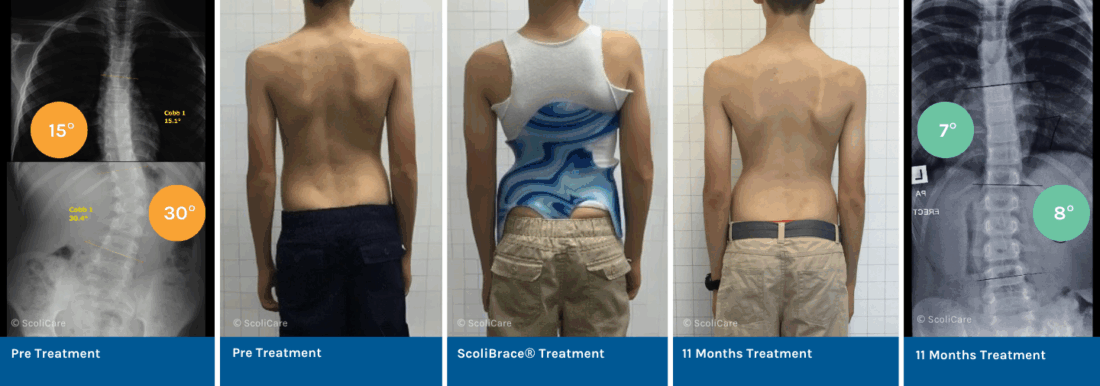
The patient presented to the clinic at age 11 for assessment of an idiopathic scoliosis that had been diagnosed by a paediatrician five years earlier. He was an active young male involved in judo and Brazilian jiu-jitsu, and had been experiencing occasional lower back pain. At the time of presentation, he had a 30° left lumbar and 15° right thoracic curve. Clinical tests for leg-length inequality (LLI) also indicated a short left-leg (approximately 20mm) relative to the right leg. X-ray evaluation confirmed that a 28 mm lift was required to level the pelvis. He was skeletally immature (Risser 0) and had a positive family history of scoliosis.
The patient was prescribed part-time ScoliBrace® wear (up to 16 hours/day), a daily ScoliBalance® program of scoliosis-specific exercises, and home traction with a ScoliRoll® device. He was also recommended to wear a shoe lift (20mm) and a heel lift (8mm) to address the leg length discrepancy. The patient was also provided with an ischial lift to use whenever seated to counter the effects of the sacral/pelvic obliquity on the patient’s curves.
Results
- Initial Correction: One month after beginning treatment, X-rays (with the patient also wearing their shoe and heel lift) showed reduction of both the primary and secondary curve to 13° and 10° (reductions of 57% and 33% respectively).
- Sustained Improvement: After 11 months of treatment, both curves had reduced to under 10° Cobb while using the shoe and heel lift and out of brace. .
- Postural Balance Restored: The most recent physical examination revealed that the patient’s posture was more balanced and the angle of trunk rotation measured 4° in the thoracic spine and 0° in the lumbar spine with the patient wearing their heel lift.
The patient remained under non-surgical management, with the goal of maintaining correction through continued exercise and monitoring as he progressed through growth.
NB: Results vary from case to case. Our commitment is to recommend the most appropriate treatment based on the patient’s individual case.
Interested in a non-surgical, evidence-based approach to managing Juvenile Idiopathic Scoliosis? Get in touch with a ScoliBrace Provider near you to discuss your child’s case and explore how custom bracing can make a difference.